Sweden’s acquisition of new frigates is, at its core, a strategic decision.
It is not only a matter of industry, regional politics, or international relations, but of when Sweden will actually have an operational sea-based air defence capability.
In today’s security environment, the time dimension is not a technical detail. It is a strategic parameter.
When do delays arise in major naval programmes?
International experience shows that large warship programmes are rarely delayed primarily due to the production pace at the shipyard. Delays usually originate earlier, in the design phase. Typical causes include:
- Insufficiently mature design at the start of production
- Changes in requirements during construction
- System integration running in parallel with structural work
- Weaknesses in configuration management
- Lack of clarity in the division of responsibilities between design and integration
When the architecture is not stabilised and locked at the right stage, cascading effects follow: rework, sequence disruptions, supply chain disturbances and ultimately delivery postponements.
Production is therefore not the main problem, but the consequence of prior instability in design. The central question is: is the platform based on an already realised and proven architecture, or on a broader new build?
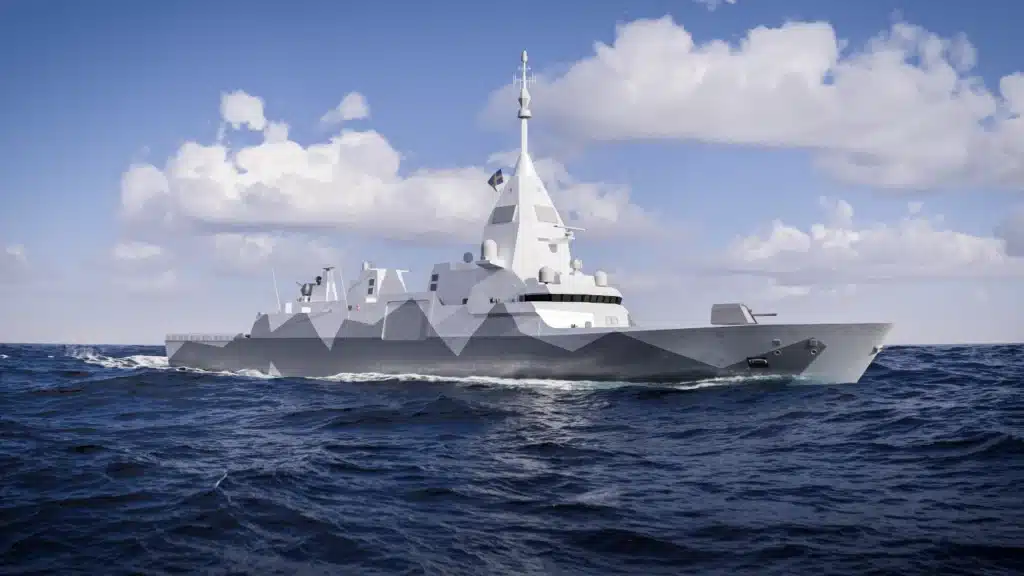
Artist’s impression: Navantia
An evolutionary architecture: F100 → F110 → ALFA 4000
The Spanish design line illustrates an evolutionary approach:
- Álvaro de Bazán class (F100) – operational AEGIS platform with extensive NATO experience
- F110 class – an evolution of the F100 architecture
- ALFA 4000 – a configuration derived from that architecture
The F110 programme has been developed using digital twin and model based systems engineering (MBSE), enabling early design freeze, requirement traceability and strict configuration control. This means that ALFA 4000 should not be considered an isolated new construction but rather a variant within an already materialised system architecture. When the architecture is evolutionary, the likelihood of late changes decreases – reducing schedule risk.
In a European context, where several major surface ship programmes have undergone renegotiations and schedule revisions, design maturity takes on special analytical weight. Experience shows that when production begins before the architecture, main systems and technical interfaces are fully stabilised, risk shifts from the design phase to the construction phase. At that point, every modification becomes more expensive and more disruptive to the schedule. Adjustments in power generation, cooling capacity, weight balance, or system integration can trigger chain effects across the entire delivery sequence.
In light of this, it is also relevant to consider actual delivery history. For roughly the past 25 years, Navantia has executed its major surface ship programmes without missing fundamental contractual delivery milestones. This does not mean the programmes have been free of technical challenges – which are inherent in any complex defence project – but the contractual delivery points have been met. In a European environment, in which several projects have required substantial adjustments in time and budget, sustained discipline in execution becomes a structural indicator of reliability.
Sweden’s industrial strategy
Around 2018, Saab Kockums defined its strategic orientation: to focus on the development and production of submarines, underwater technologies and advanced constructions – including composite solutions – rather than maintaining a full steel construction capacity for large surface vessels. This was a strategy of specialisation. The logic was clear:
- Sweden should lead in certain key technological areas.
- Platform construction can be carried out in cooperation.
- System integration and combat management expertise are essential Swedish strengths.
Under this model, the central issue is not where each steel plate is welded – which SSAB can supply – but how Swedish system competence is integrated into a delivery model with low schedule risk
The platform from an allied perspective
Spain has been a NATO member since 1982. A Swedish frigate platform of European origin would, in practice, incorporate multiple systems from established Alliance suppliers, for example:
- Saab – combat management system, sensors, anti-submarine warfare (ASW) torpedoes, surface-to-surface missiles
- MBDA – air defence effectors
- Thales – ASW sensors
- BAE Systems Bofors – naval artillery
Operational value therefore depends less on national labels and more on architecture maturity, integration risk and delivery reliability.
The time dimension after joining NATO
Since joining NATO, Sweden is part of regional defence plans with defined capability objectives and timelines. The difference between achieving operational capability in 2030 or 2033 is not merely administrative. In an unstable security environment, three years of delay may imply:
- A prolonged period with limited sea-based air defence capability
- Increased pressure on other platforms
- Reduced freedom of action in regional planning
- Lower interoperability in early phases
Time to operational capability is therefore a factor of strategic security, not just project management.
Conclusion: capability, risk and time
Sweden has adopted an industrial strategy based on specialisation and system competence. The frigate decision is not about whether industry should be prioritised, but how the chosen model aligns with:
- Architecture maturity
- Integration risk
- Configuration control
- Delivery predictability
- Time to operational capability
In a more uncertain international environment, the time dimension tends to gain strategic relevance. For this reason, delivery reliability and capacity available on time may justifiably carry significant weight in the overall evaluation, along with industrial and political considerations.