
Focus on maritime security
The global offshore patrol vessel market is characterised by a robust growth that is driven by increasing maritime security threats, territorial disputes and the need to protect offshore assets like oil and gas installations.
Escalating maritime security threats are the reason why many maritime nations are investing in offshore patrol vessels (OPVs).
‘Flagship’ building programmes exist in Australia, Bulgaria, Colombia, France, Italy, Japan, Malaysia, Mexico, Tunisia and the Philippines. Some minor efforts are being reported from West African nations, including Nigeria. Additionally, information surfaced in September 2024 following the signing of a “tripartite alliance” between Italian shipbuilder Fincantieri, Vard Marine (a Fincantieri company) and Sandrock Austral Shipyards (SA Shipyards) headquartered in Durban, South Africa. The “OPV alliance” is seen by observers to help reshape the landscape of African maritime security. It calls for the so-called Africa Offshore Patrol Vessel – VARD 7 055 – built “in Africa and for Africa”.
To be clear, many of the global OPV new-construction programmes currently coming on stream do have a focus on the adoption of more modular platforms with multi-role functionalities as opposed to single roles, thus extending their operational flexibility in the ’blue water’ environment. The VARD 7 055 patrol vessel itself is a testament to cutting-edge engineering, purpose-built to address the multifaceted challenges facing African navies, coast guards and law enforcement agencies, according to the Tripartite Alliance industrial partners.
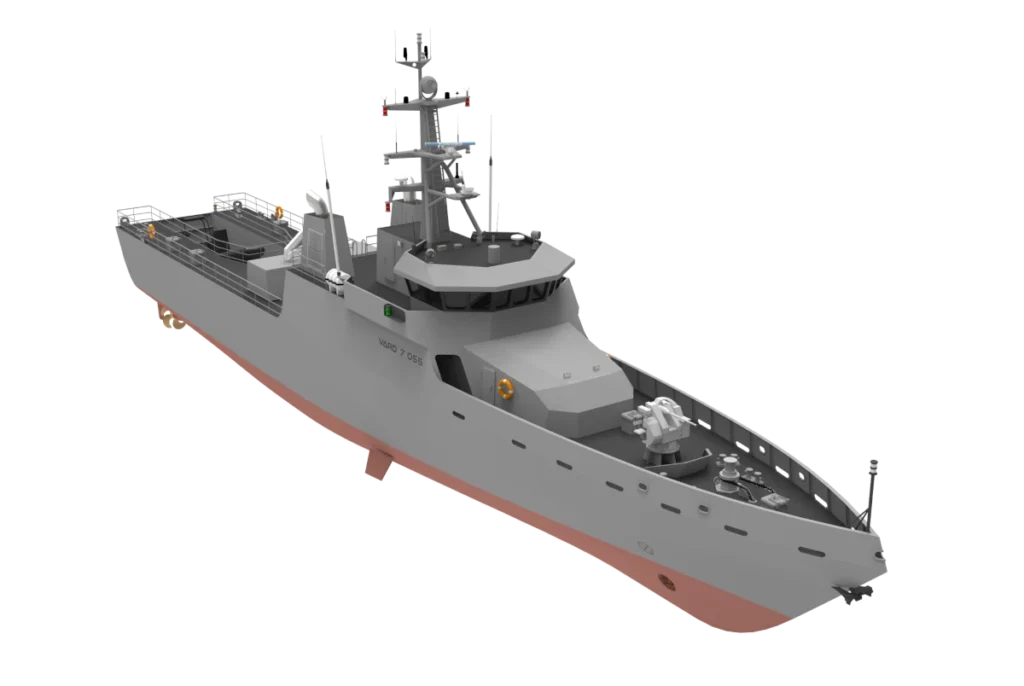
Artist’s impression Tripartite Alliance
Danger zones
The demand for OPVs is predominantly driven by the economic significance of offshore oil and gas fields, wind farms and underwater infrastructure. The African Union’s (AU) Integrated Maritime Strategy 2050 (AIMS 2050) warned that the threat spectrum is further increasing for most of the 38 African countries that are either coastal or island states. This implies that maritime security is put high on the agenda. One figure indicates the situation that is considered to be concerning: 52 of the 100 port facilities in these countries are under constant threat – the great majority of them consisting of armed attacks on commercial shipping in coastal waters, along major river streams and in harbours, as well as armed robbery and crew kidnapping. In addition, in the African maritime domain, there are renewable marine resources and plenty of oil and gas drilling and production sites, many of them face “an extraordinary” high level of threat, according to the International Maritime Bureau (IMB). This is the case for several West African countries, including Angola. Here, the IMB “Piracy and Armed Robbery Against Ships Report” for the brief period of January to March 2024 outlines a “noticeable number” of actual and attempted incidents in Angolan waters: four against anchored vessels, three of which were attacked at the Port of Luanda, the largest port in Angola. In total, six incidents were reported for the Gulf of Guinea, according to the IMB report. In Nigerian waters, civil strife and insurgent attacks have been registered, targeting private oil and gas infrastructures, including offshore platforms and undersea pipelines, which all complicate policing efforts. Much of Nigeria’s piracy problem stem from well-organized criminal elements deep inside the country’s delta region.
Presence in the danger zones
The presence of the Spanish Navy’s offshore patrol vessel SPS Furor (P 46) in the Gulf of Guinea this year is indicative of attempts by NATO, European Union (EU) and other governmental organizations to increase maritime security, enhance the awareness of the maritime domain and promote cooperation with the region’s coastal countries. Her deployment to the region will be for the first half of 2026 in support of an EU operation of maritime surveillance and international cooperation. The Meteoro class patrol vessel began her new deployment in early January on the West coast of Africa and the Gulf of Guinea as part of the EU’s initiative “Coordinated Maritime Presence in the Gulf of Guinea. The commander of the patrol vessel, Lieutenant Commander Ángel García, said: “After a demanding period of preparation and certification, which we have carried out over the last year and a half. A demanding task that is rewarded with the opportunity to represent Spain in a strategic region.” The sixth unit in the class and part of the second batch of Navantia’s BAMS (Buque de Acción Marítima) delivered to the Spanish Navy (Armada) on 21 January 2019, the SPS Furor operates from Cartagena Naval Base (Arsenal de Cartagena).
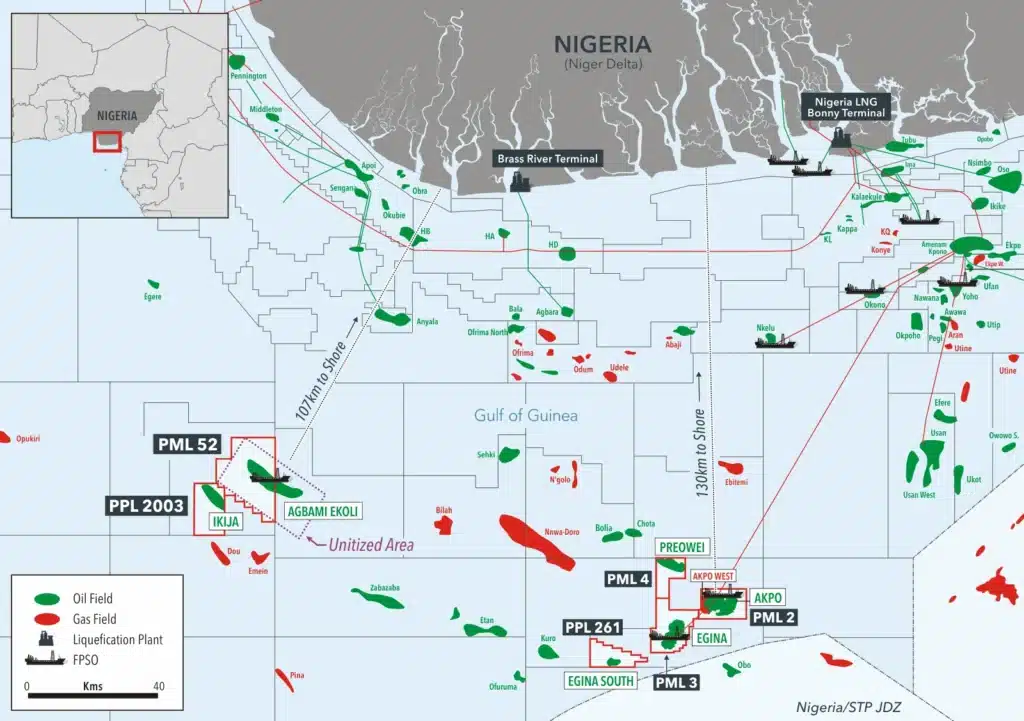
Map: JDZ Investment International Limited
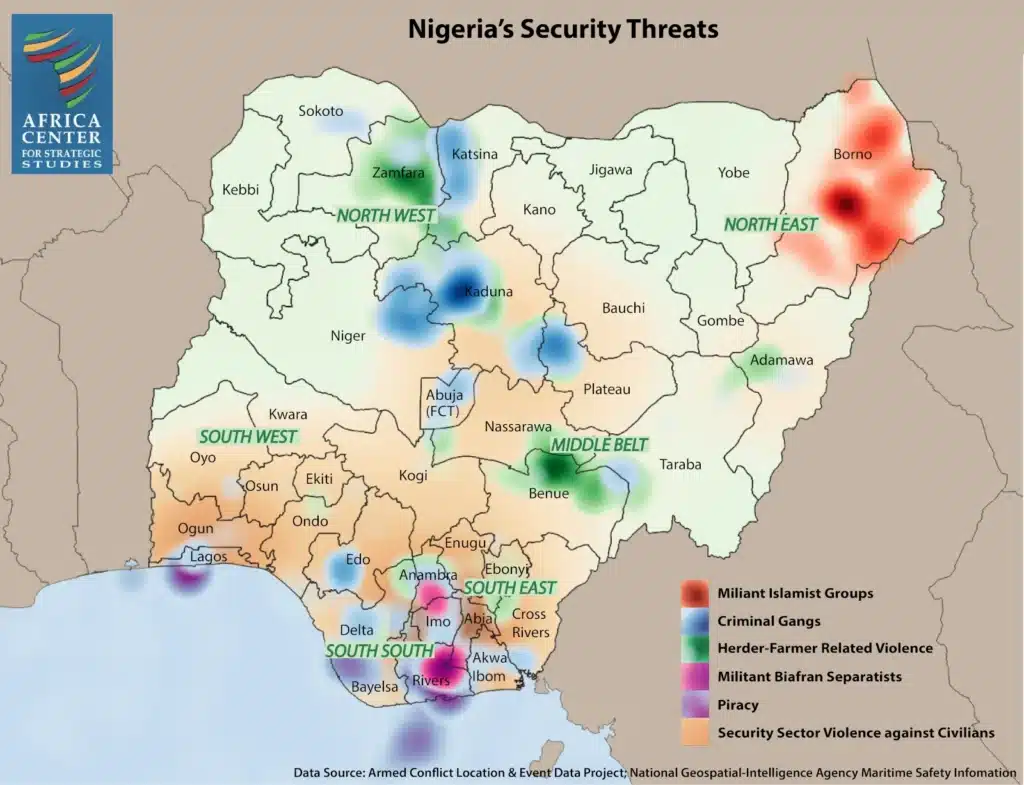
Map: Africa Center for Strategic Studies/National Geospatial-Intelligence Agency Maritime Safety Information
Additionally, the Royal Navy (RN) has helped West African nations counter pirates and smugglers and strengthened ties in the region over many years. In 2023 and 2024, the patrol vessel HMS Trent (P 224), a Batch 2 River class OPV, participated in “Exercise Grand African NEMO” to enhance cooperation against maritime crime in the Gulf of Guinea. The OPV has been deployed with a specialist Royal Marines boarding team and a Puma remotely-operated air system from 700X Naval Air Squadron. During her deployment in the Gulf of Guinea, the patrol vessel worked with navies from Guinea-Bissau, The Gambia and Senegal.
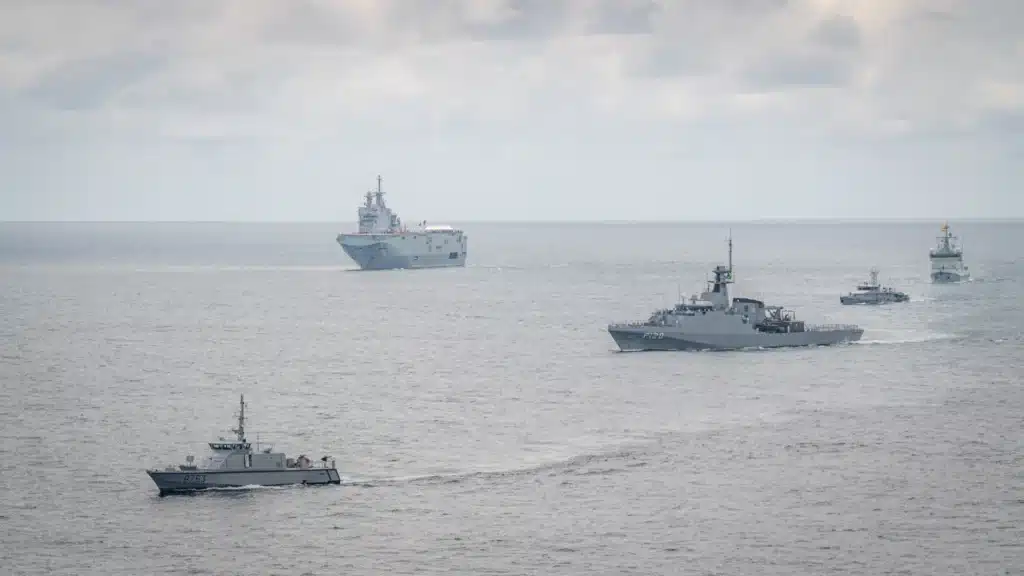
Photo: Marine National/Préfecture maritime de l’Atlantique
What patrol vessels can do
Among the West African countries, both Nigeria and Angola are at risk, facing irregular, but – from time to time – increasing actions by local terrorist organizations, criminal groups and individuals. The second strongest economy on the continent (after the Republic of South Africa) and an emerging market, Nigeria faces threats to her oil sector in particular. Although oil revenues contributed roughly two thirds of state revenues, oil only contributes about 9 percent to the nation’s GDP (gross domestic product). However, Nigeria produces about 2.7 percent of the global oil supply.
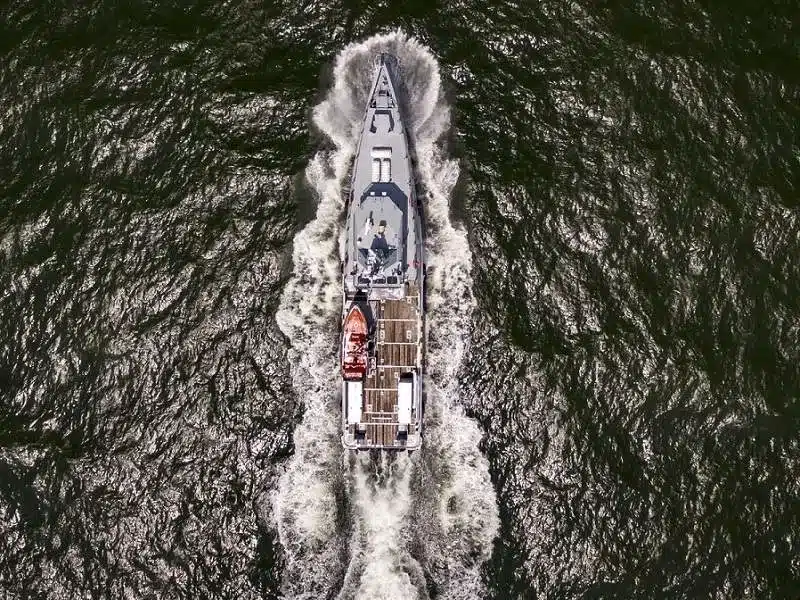
Photo: Damen Shipyards Group
Within the Gulf of Guinea, Nigeria continues to state that it will enhance surveillance and increased patrolling of its maritime domain in response to a recent spate of incidents that have seen crews kidnapped within recent weeks in neighboring waters, according to Dryad Global in its Weekly Maritime Security Threat Advisory, released for the week commencing 15 May 2023. Stanley Akpesiri, chief executive officer of Oceansafe Limited, an organization founded in 2021 offering maritime logistics and security services, has called for a stronger maritime security, increased private sector participation and strict compliance with global standards to sustain Nigeria’s oil and gas industry. He said maritime logistics and offshore security remained critical to protecting energy assets and ensuring uninterrupted operations, particularly as Nigeria seeks to boost production and attract new investments into the sector.
In doing so, the leading West African offshore services supplier, Nigerian Homeland Integrated Offshore Services (Homeland IOSL), received two additional Fast Crew Supplier (FCS) 3307 vessels from Damen Shipyards Group in the Netherlands. Configured as patrol boats, Homeland IOSL intends to deploy the vessels in the Gulf of Guinea to protect and support the offshore assets of Homeland’s clients which include many of the leading international oil companies. The 33m long vessels is characterized by its Sea Axe hull shape. It offers “excellent manoeuvrability and first-class seakeeping combined with superb fuel economy” and a top speed of 28 knots, said Damen Shipyards group. The latest additions to the fleet – Guardian 9 and Guardian 10 – are powered by three Caterpillar main engines delivering 3,250 kilowatts to three fixed pitch propellers via three Reintjes WVS series gearboxes. The vessels offer a range of 1,000 nautical miles at full speed and with full complements of six crew and twelve security personnel. Reports noted that they will be technically the “ideal combination” needed to remain at sea for up to four weeks in and around Nigeria’s coastal and offshore oil fields.
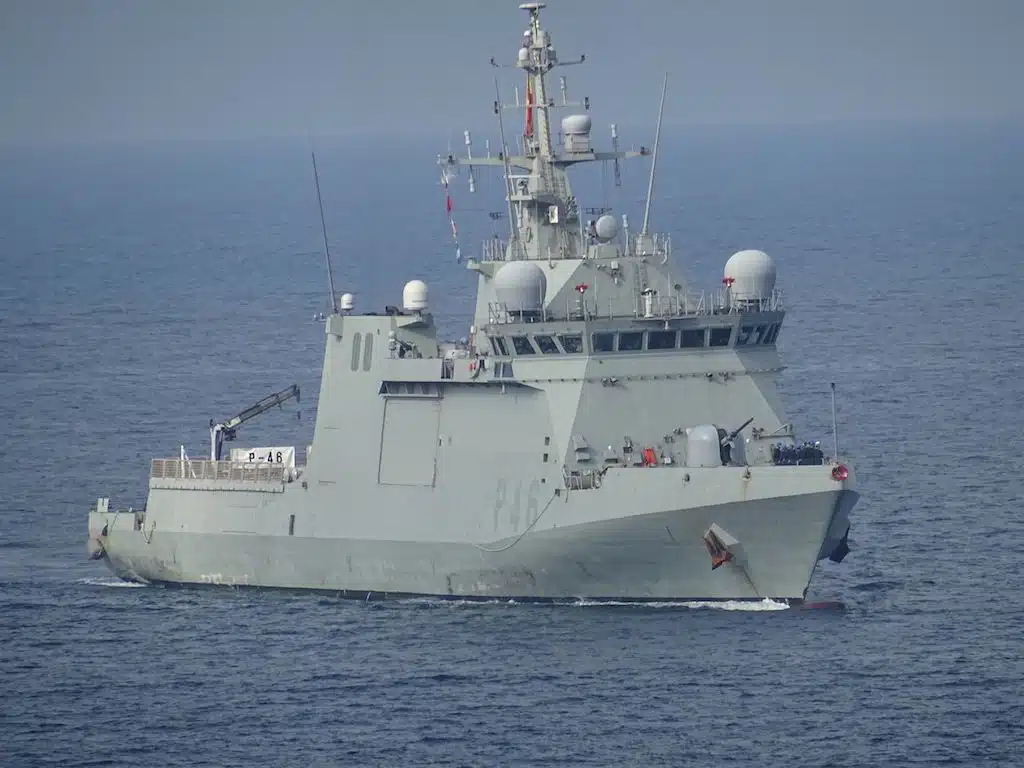
Photo: Spanish Navy
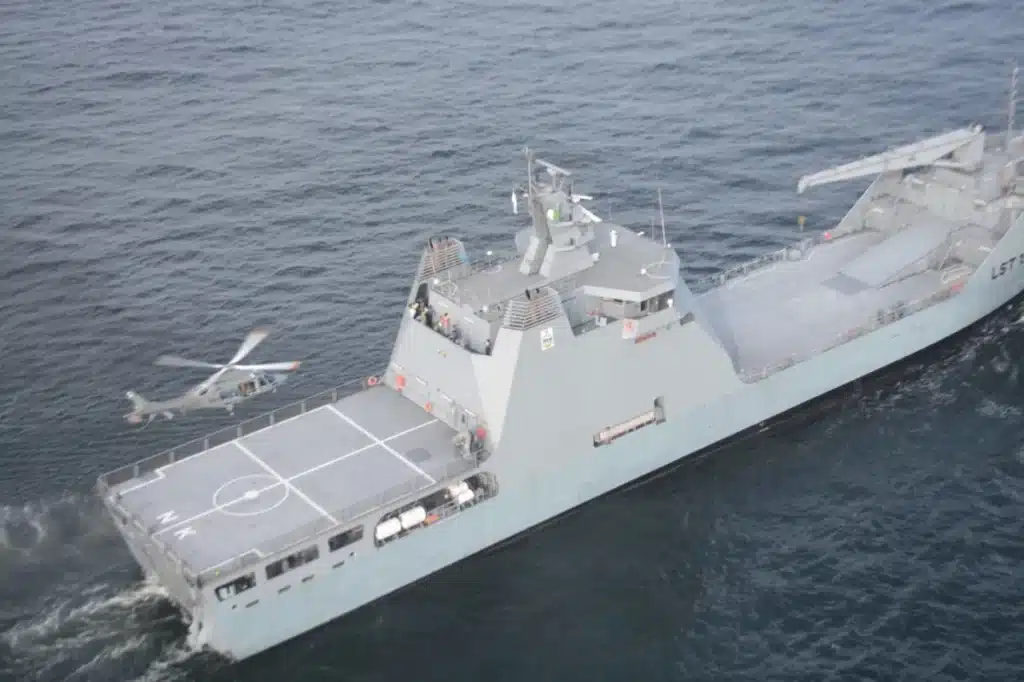
for strategic transport of equipment and troops, humanitarian assistance and disaster relief operations, as well as to project maritime security into the Gulf of Guinea.
Photo: Nigerian Navy
In North Africa, Tunisia also decided to go for the innovative Sea Axe hull shape. Four examples of Damen’s MSOPV 1400 design have been delivered to the Tunisian National Navy (Marine nationale tunisienne) and commissioned into service in 2019. MSOPV, an acronym for Multi Service Offshore Patrol Vessel, represents Damen’s second-generation OPV design that incorporates the Sea Axe hull shape for “superior” seakeeping, according to the shipbuilder. The 72m long, 1,877-tonne (full displacement) OPV comes with a multi-mission bay that can be equipped with dedicated mission modules and a 9-m rigid-hulled inflatable boat (RHIB). This makes the patrol vessel an ideal addition to existing surface assets for protecting coastal waters, harbours and critical infrastructure. It is interesting to note that two of the four vessels – Hannon (P 612) and Sophonisbe (P 613) – are fitted with a helicopter deck. Their multi-mission hangar is capable of accommodating and handling a helicopter and an unmanned aerial vehicle (UAV). In summary, the use of unmanned systems – UAVs or drones and unmanned underwater vehicles (UUVs) in particular – adds significant new capability to new and existing classes of patrol vessels, a capability intimately associated with many classes of frigate-size combatants.
The OPV portfolio on offer by Germany’s NVL Group (now part of Rheinmetall) is a high-end one, used by maritime organisations for varying maritime tasks, including Australia and the Sultanate of Brunei. The ongoing construction and delivery of twelve Arafura class OPVs (based on the Lürssen-designed Darussalam class operated by the Royal Brunei Navy) adds significant capability to the Royal Australian Navy’s (RAN) surface fleet, replacing four separate ship classes (including the Armidale class patrol boats). The Arafura class will take on some of the duties associated with the Huon class minehunters, as well as Leeuwin and Paluma class survey vessels. These new patrol vessels are designed to use a modular mission payload system to fulfill specific roles – primarily border patrol, mine warfare and hydrographic survey. Construction of the ships is underway at NVL Group’s subsidiary Luerssen Australia Pty Ltd., partnering with ASC Shipbuilding for construction of the first two OPVs in South Australia) and Civmec Construction for the remaining ten in Western Australia.
In Bulgaria, the Multipurpose Modular Patrol Vessel (MMPV) ordered from NVL Group will feature a complete array of ultra-modern systems and subsystems, including an integrated combat management system (9LV Mk4) from Saab Group. Bulgaria ordered two units that are based on the OPV 90 design, which make them ideal platforms for tasks within the framework of international alliance missions of NATO and the EU, enabling the Bulgarian Navy to counter air- and land-based threats, as well as surface and undersea threats. For this purpose, the two steel monohull MMPVs are to be fitted with an impressive array of weapons: four Saab RBS15 Mk3 anti-ship missiles; eight MBDA VL Mica surface-to-air missiles fired from an eight-cell vertical launch system; two 324mm torpedo launching systems; one 76/62 SR (Super Rapid) naval gun from Leonardo; and one Rheinmetall Oerlikon 35mm Millennium gun. Among the sensor systems is a Saab Sea Giraffe 4A multifunction radar with integrated IFF (identification friend or foe) and the same company’s Ceros 200 fire control radar mounted atop the bridge. A basic electronic warfare (EW) system – consisting of Saab’s SME series electronic support measures (ESM) suite fitted to the forward mast and Rheinmetall’s MASS decoy launching system – adds to the unique capability of the new OPVs. They have a full displacement of approximately 2,300 tonnes, with an overall length of 90m, a beam of 13.5m and a 3.5-m draught. The first unit – Hrabri – began her sea trials in November 2025 while the second unit – Smeli – is expected to be on delivery later this year.
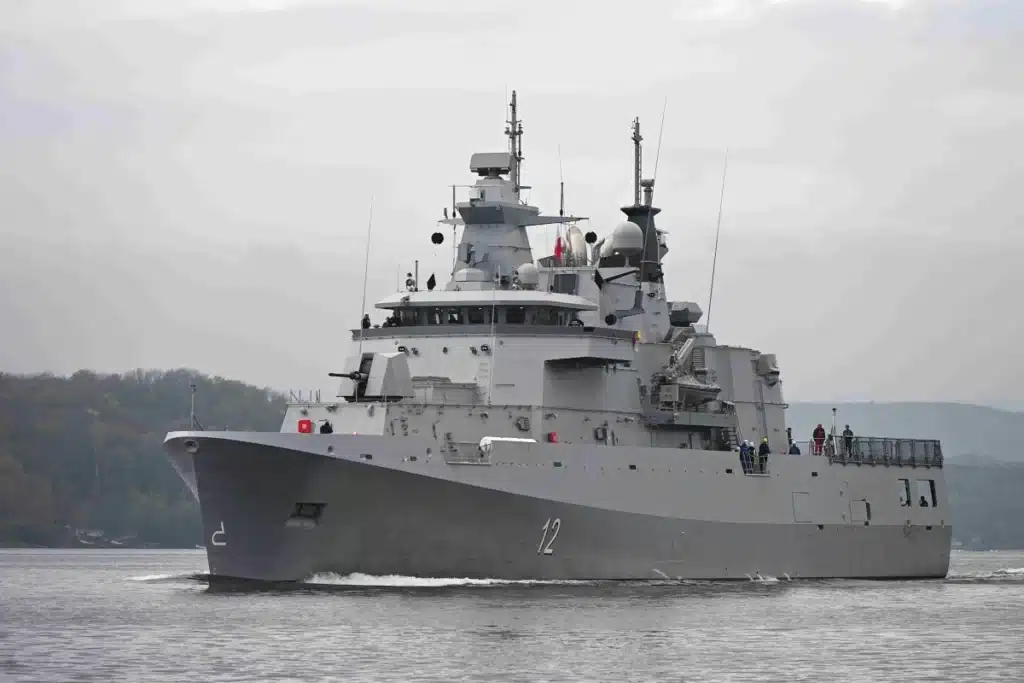
Photo: Ministry of Defence of Bulgaria
One trend is typifying the modern OPV: the use of manned/unmanned aviation like helicopters and drones (unmanned aerial vehicles; UAVs) for enhanced maritime security. In a recent night landing experiment, the RN’s Batch 2 patrol vessel HMS Trent was used to showcase the Glamox Helicopter Visual Landing Aid System (HVLAS) to enhance the vessel’s ability to land helicopters in rough seas and at night from the UK and partner nations. The HVLAS was installed on HMS Trent in 2025 by Glamox’s customer du Pré Marine. The landing experiment of a US Coast Guard helicopter took place off the coast of Miami, Florida, providing valuable aviation training for day and night landings. This enhanced operational flexibility is important, particularly for disaster relief and aid operations in regions such as the Caribbean. Lou Lewis, a business development manager at Glamox’s Defence and Security business in the UK noted: “We were contracted to supply systems for two Royal Navy vessels, HMS Trent and HMS Spey, and aspire to enhance the aviation capabilities of the remaining Royal Navy Batch 2 offshore patrol vessels.” The Glamox HVLAS is a complete flight deck LED lighting system that provides pilots with visual cues and information during approach and landing. It includes a stabilised horizon bar that indicates the horizon’s position, regardless of the vessel’s roll and pitch. Also, a glide path indicator helps pilots judge approach angles by using a three-colour light beam to show the correct path or whether the helicopter is too high or too low.
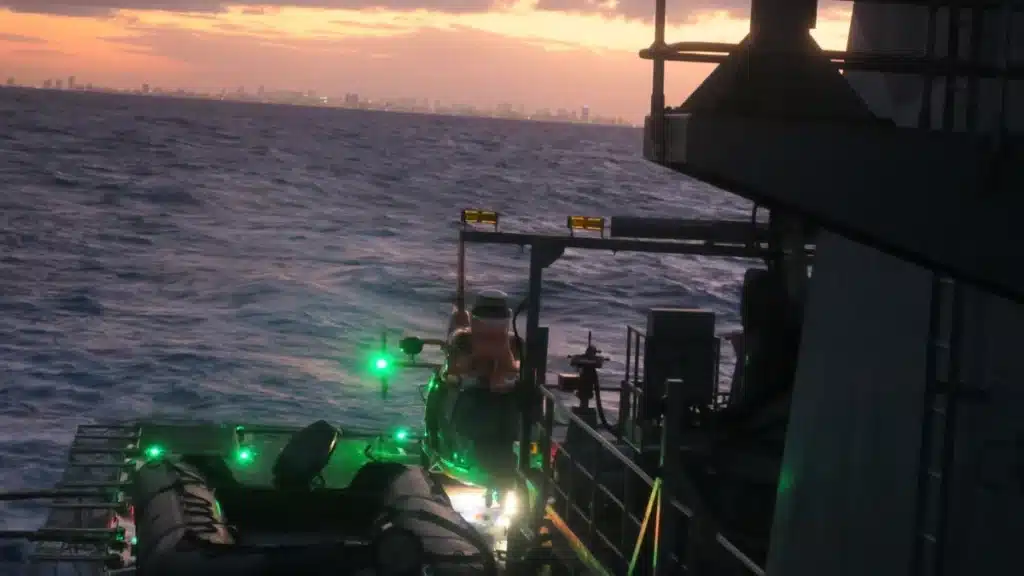
Photos: Glamox AS
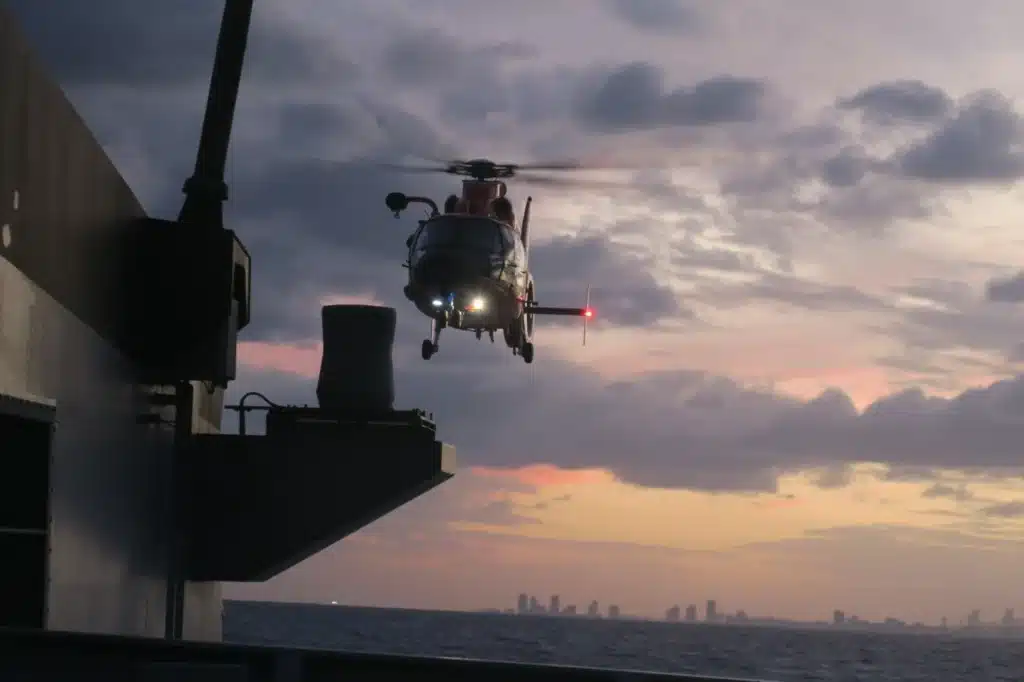
Photos: Glamox AS
Conclusion
The prefix ‘OPV’ will continue to shape the maritime security domain. The modern OPV will be able to fill existing capability gaps: naval/maritime services need them, in addition to other types of surface combatants – corvettes and frigates – to control their maritime territory, and for deterrence. New requirements, e.g., for complex mission modules, determine the capability of the new-generation OPV. “Plug & play” is the decisive technological trend here. Countries with limited defence expenditures, especially those located along the African continent’s west coast that are in part extremely rich in natural resources (e.g., hydrocarbons), can benefit from a great variety of OPV designs to provide sufficient maritime security in times of steadily increasing maritime security threats and territorial disputes. Other regions on the African continent, namely those countries belonging to the East African Community (an economic and political block consisting of e.g., Kenya, Tanzania, Mozambique and Madagascar), are also in demand of new patrol vessels.
Through the use of state-of-the-art technologies, the modern OPV is able to do more than earlier platforms of the 1990s and 2000s that were designed with relatively limited range, endurance, seakeeping and capability. With costs typically less than half that of a new frigate, it is no wonder that user countries are continuing to focus their efforts on the maritime security-focused OPV that is able to cope with completely new threats and requirements, despite declining expenditures on defence and security.