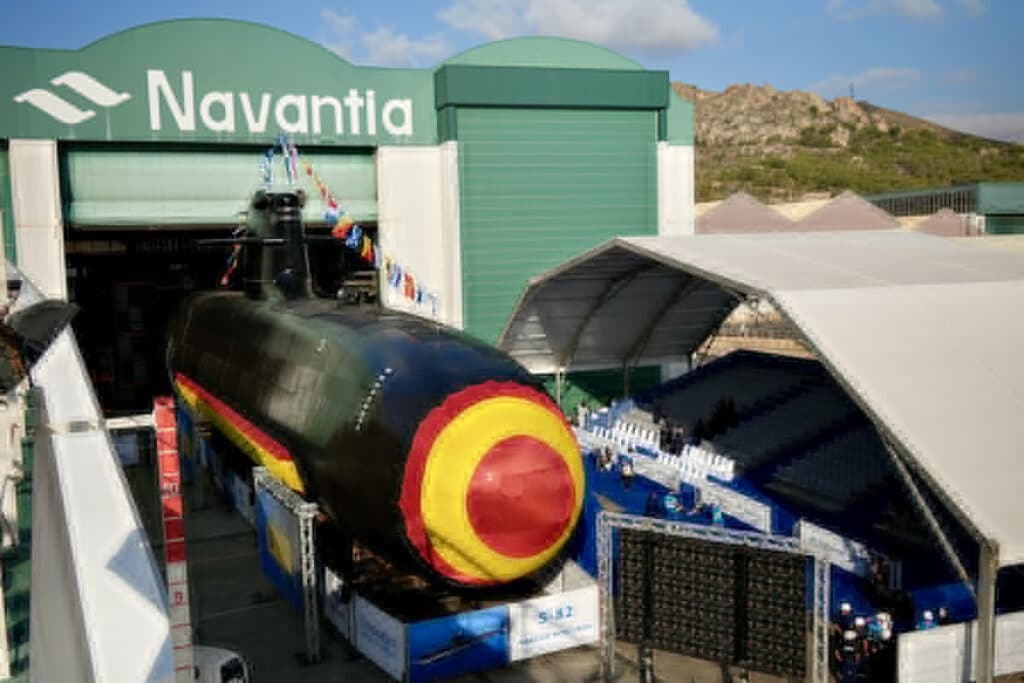
Navantia, at their Cartagena shipyard in the Region of Murcia in southeastern Spain, has begun testing of the air independent propulsion (AIP) system already incorporated into the section of the third S-80 series submarine SPS Cosme García (S 83).
The final tests were set to begin after all prior installation work on the various pieces of equipment required for their proper execution has been completed. The tests will make it possible to carry out the necessary adjustments to the system in its actual location before joining the 12-metre-long, approximately 400-tonne section to the rest of the submarine’s pressure hull. The S 83’s section carrying the AIP is located in a special test facility at the Cartagena shipyard, known as IPS3, where a multidisciplinary task force from the Submarine Business has carried out all the necessary checks to begin testing.
Clear mission to fulfil: The modernisation of the Spanish Submarine Force (COMSUBMAR) achieved a major milestone with the commissioning of SPS Isaac Peral (S 81) on 30 November 2023, the first of four Isaac Peral (S-80) class long-range conventional attack submarines. Spain’s Ministry of Defence (Ministerio de Defensa de España; MINISDEF) considered the S-80 attack submarine programme a priority effort. The MINISDEF emphasised the need to procure new-generation submarines to retain the nation’s submarine capacity with two submarines operating simultaneously in two theatres. Within this scheme, the S-80 was designed to undertake a variety of roles, among them anti-surface warfare (ASuW), anti-submarine warfare (ASW), special operations, selective land attack, intelligence, surveillance and reconnaissance (ISR), as well as minelaying.
How capability matters: Testing of the AIP on the third S-80 submarine has begun with the first loading of liquid oxygen and bioethanol, from which the system produces hydrogen to fuel its hydrogen fuel cell and propel the submarine while submerged. It is – in principle – a third-generation AIP system that does not carry stored hydrogen, but generates it on demand from a liquid fuel, thus overcoming the limitations of previous generations currently in operation. AIP will give the S-80 submarines the ability to operate submerged for weeks rather than days – the period for which current conventional submarines equipped with lead-acid batteries can remain underwater.
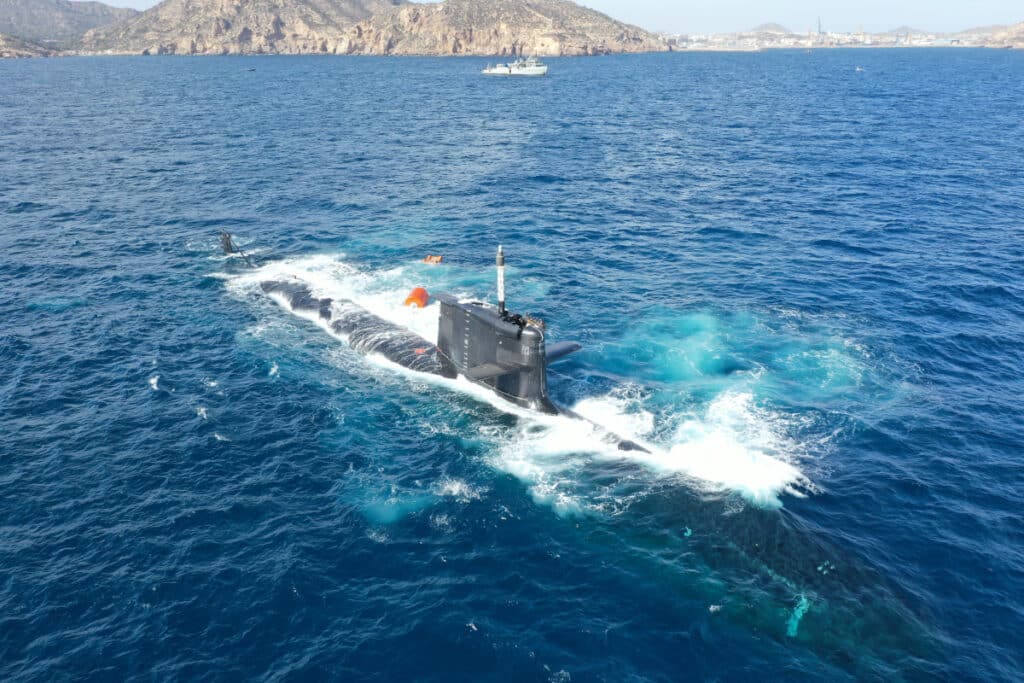
The anaerobic propulsion system developed for the S-80 submarines is described to be “revolutionary”; called BEST-AIP, it provides great stealth while submerged. This atmosphere-independent propulsion system allows the generation of electrical energy from fuel cells using technology derived from the aerospace sector, at any depth. They can remain submerged for weeks without surfacing to periscope depth, greatly enhancing their discretion, the main attribute of a submarine, placing the S-80 among the most advanced conventional (non-nuclear) submarines in the world.
The AIP will undergo the checks set out in the programme’s systems engineering manual on a unique test bench capable of simulating both the bow and stern of the submarine, as well as real operating conditions, including diving depth and the submarine’s forward speed. This will make it possible to carry out functional adjustments and demonstrations, including power generation with the AIP under various operating conditions, helping to optimise the planned schedule for testing the system in harbour. The testing process on board the S 83 section represents a new milestone for the AIP, a system with a high level of national technological content that highlights the progress of the programme, with SPS Narciso Monturiol (S 82) undergoing harbour trials and SPS Cosme García (S 83) and SPS Mateo García de los Reyes (S-84), the next two units, under construction at the Cartagena shipyard.
Thanks to the AIP system, the submarines can generate electrical power while submerged, using oxygen and bioethanol stored on board, enabling them to operate for extended periods without surfacing or carrying out snorkelling manoeuvres. With a high degree of stealth, advanced combat systems and state-of-the-art sensors, as well as a design optimised for long-duration operations, the S-80 submarines place Spain among the countries with the technological capability to develop this type of strategic platform.
Industrial excellence: The S-80 attack submarine programme has meant a technological leap for Spain’s premier naval shipbuilder Navantia and its cooperating industries, placing them at the forefront of the world’s conventional submarine market. Around one hundred companies are taking part in the programme, including SAES, Indra, Sener, Abengoa, Grupo Oesia, Gabadi and Fluidmecanica. With the aim to speed up and improve the construction of the submarines and reduce production costs, the shipyard has gradually installed robotised production systems at its plant in Cartagena. Babcock, Lockheed Martin, General Dynamics Electric Boat, Rolls-Royce Power Systems, Northrop Grumman Sperry Marine, Avio, EUROATLAS, AEROMARITIME, Sulzer, Boeing, Atlas Elektronik, Air Liquide, Exide Technologies, Saab and L3Harris Technologies are among the foreign contractors contributing to the submarine programme.
Technology to bolster maritime supremacy: The S-80 submarines measures 80.81 metres in length and 7.3 metres in diameter for a maximum beam of 11.68 metres and a draught 6.3 metres; they can reach a maximum surface speed of 10 knots and a maximum submerged speed of 19 knots. Their surface displacement is quoted at 2,696 tonnes, while the submerged displacement is 2,965 tonnes. The submarines will be able to accommodate 32 crew members and eight special forces personnel. Among their technological contributions is the so-called Integrated Combat System Core (ICSC), a combat and platform control system developed by Navantia’s Systems business unit and incorporating elements of Lockheed Martin’s International Diesel-Electric Submarine Integrated Combat System (SUBICS). Navantia also is responsible to install other equipment, including the Integrated Platform Management System (IPMS) with inertial navigation system (INS) and automatic identification system (AIS), as well as a fully integrated communications suite incorporating LF, VLF, HF, VHF, UHF, SATCOM and GPS systems, as well as the Tecnobit LINPRO multi datalink processor. Indra was tasked to deliver a wide range of mission systems for the submarines, including: Aries-S low-probability of intercept (LPI) high-resolution surface surveillance and navigation radar system; Mode 5 identification friend or foe (IFF) transponder; TSUB X- and Ku-band SATCOM terminal; and Pegaso electronic warfare suite combining radar electronic support measurement (RESM) and communications electronic support measures (CESM) with electronic intelligence (ELINT) and communications intelligence (COMINT) functionalities.