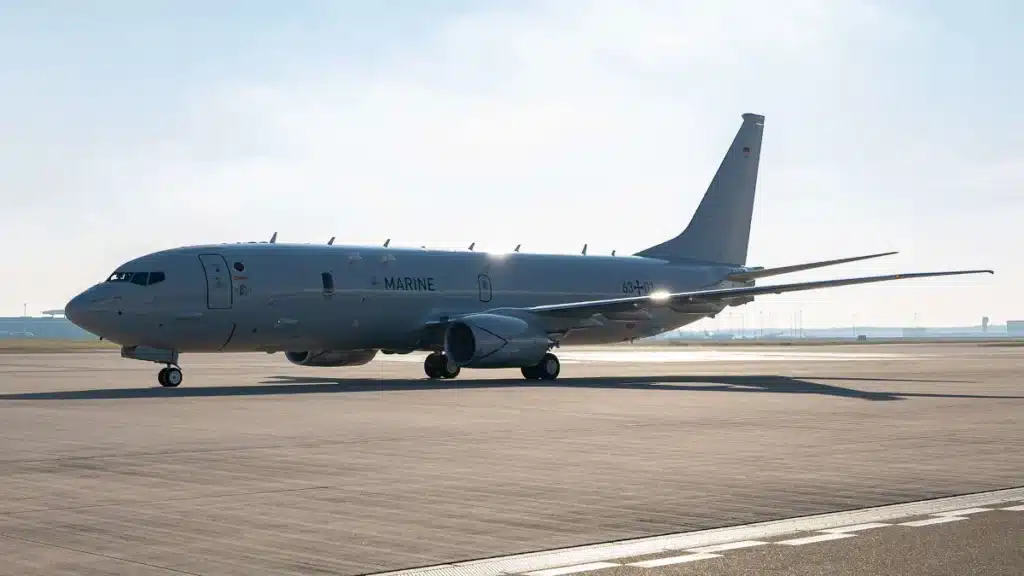

To date, the global inventory of P-8 Poseidon submarine-hunting aircraft has completed over 700,000 flight hours. The high speed of the P-8A enables it to reach its relevant area of operation more quickly than any other maritime patrol aircraft.
This strengthens NATO’s collective deterrence capability, particularly in future areas of operation – in the North Atlantic and the Baltic Sea. Intended to replace the ageing P-3C fleet, the new maritime patrol aircraft also brings new capabilities in cooperation with valued partners in the Asia-Pacific region, such as Australia, India, New Zealand, Singapore, South Korea and the United States. This global network of P-8 users also includes the United Kingdom and Norway in Europe. The P-8A on delivery to Germany (with the first airframe delivered last November) are expected to be stationed at RAF Lossiemouth in Scotland, which has been the home base of the nine British Poseidon MRA.1 aircraft ordered from the United States in July 2016 since mid-October 2020. The deployment is part of an agreement signed by the British and German defence ministers in London on 23 October 2024 – the so-called Trinity House Agreement.
The German-British agreement states that German P-8A surveillance aircraft will be deployed from Scotland over the North Atlantic for surveillance tasks. These could then be used together with British forces for long-range surveillance and reconnaissance functions, but also as a ‘force multiplier’ to contribute significantly to the information, command and operational superiority of their own and allied armed forces. During his talks in Reykjavik (on 19 October), Defence Minister Boris Pistorius closer military cooperation between the two countries. This brings the North Pole region (Arctic), which is increasingly influenced by Russia and other powers (China), to the centre of certain considerations. One aspect that has been influencing this since the start of the war in Ukraine, at the latest, is the protection of critical infrastructure – from undersea cables to natural gas production facilities. There are more than enough of these in the North Atlantic and the adjacent inland seas (Baltic Sea). They must be protected more than ever before against possible attacks. Maritime reconnaissance aircraft play an important role here.